Learn 08 T20 World Cup betting tips, from team form and pitch reports to odds and bankroll control, plus common mistakes to avoid when placing an informed bet.
T20 World Cup matches change fast; one quiet Powerplay or a few costly death overs can flip a result in minutes, so guesswork rarely works. Smart T20 World Cup betting tips start with preparation: team form, pitch, players, toss, and odds. This guide covers eight practical tips and the common mistakes to avoid. No tip guarantees a win, so bet responsibly and only if you are 18 or older.
Every T20 match has patterns worth reading before the first ball
08 T20 World Cup betting tips to analyse matches
Every T20 match has patterns worth reading before the first ball. If you are wondering how to bet on T20 World Cup matches, these eight tips show what to check, from team form to pitch conditions to odds, markets and budget, so each bet rests on research rather than hunches.
08 T20 World Cup betting tips to analyse matches
#1. Analyse recent team form and head-to-head records
Recent form shows how a team is playing right now. Look at the last five to ten T20Is and not just the results but also who they beat and how. A narrow win over a lower-ranked side says less than a convincing chase against a top team. Check the pattern behind the results too. A side that keeps losing early wickets or leaks runs in the final overs may be weaker than its win-loss record suggests, while a team on a losing run may have only lost close games.
Analyse recent team form and head-to-head records
Head-to-head records add useful content, but use them with care. Recent meetings carry more weight than old ones, since squads, captains, and playing styles change quickly. Some teams also have a habit of struggling against a particular style, such as left-arm spin or express pace.
Use form and head-to-head together when following T20 cricket betting tips. A team with strong recent form and a good record against the opponent has a clearer edge than one that only has an old record to lean on.
#2. Check the pitch report and ground conditions
The pitch often shapes how a T20 match plays out, so read the pitch report before placing a bet. A flat, hard surface usually favours batters and produces high totals, while a dry, slow one grips the ball and helps spinners. A surface with grass or moisture can give seamers extra movement in the early overs.
Check the pitch report and ground conditions
Check recent scores at the venue too. If first-innings totals regularly cross 170, a low-scoring game is less likely than at a ground where 140 is competitive. Boundary size matters as well, since short boundaries make sixes easier to hit.
Weather needs a quick look close to the start time. Humidity can make the ball harder to grip, and rain can shorten the game or change the target through DLS, so factor it into your T20 betting strategy.
#3. Compare T20 player stats: strike rate, wickets, recent form
Player stats show who is likely to make the difference, but only the right numbers help. Career averages can mislead in T20s, so focus on T20-Specific figures. For batters, strike rate matters as much as runs, since 40 off 25 balls helps a side far more than 40 off 35. For bowlers, economy rate and wickets show who keeps the pressure on.
Compare T20 player stats: strike rate, wickets, recent form
Recent form carries more weight than reputation. Look at the last five to eight T20 innings or spells, and check whether a player scores consistently or relies on one big knock. A bowler whose wickets have dried up or whose economy rate has crept up is worth a second look before you back him.
Matchups are worth checking too. Some batters struggle against left-arm spin, while some bowlers find it hard to contain left-handers. Pair this with fitness news, since a player returning from injury may not be at full strength yet, and his recent number may not tell the full story.
#4. Assess the toss and confirmed playing XI
The toss can shape a T20 match, so check it before you bet. Many teams prefer to chase because they know the target, but the right choice depends on the venue. Dew in evening games can make bowling harder in the second innings, while a slow, tired pitch may fall out for the side betting first.
Assess the toss and confirmed playing XI
The confirmed playing XI is just as important. Teams announce it at the toss, so a pre-match tip can change quickly. Check whether a key opener, strike bowler, or finisher is missing, and whether the team has swapped a seamer for an extra spinner to suit the pitch.
Look at the balance of the side too. A team with only four or five bowling options, or a long tail, can struggle if one player has an off day. A sound T20 cricket betting strategy is to wait for the confirmed lineup before finalising any bet.
#5. Understand betting odds and implied probability
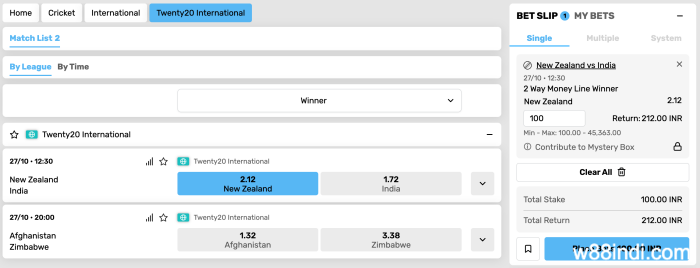
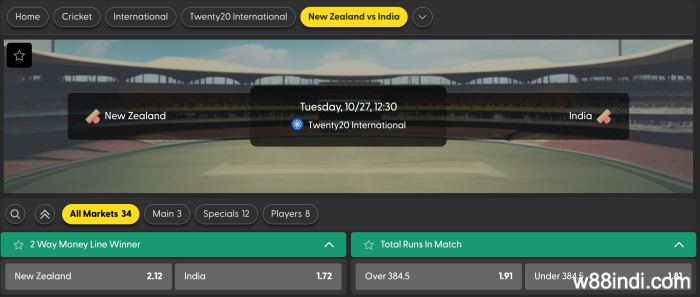
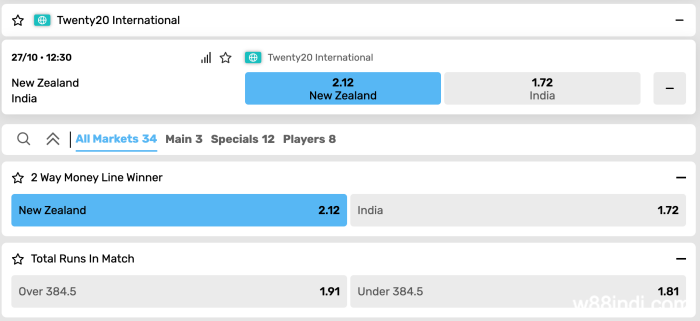
Odds show what a bookmaker will pay, but they also reveal how likely the bookmaker thinks each outcome is. In online cricket betting, converting them into implied probability makes prices easier to compare.
Understand betting odds and implied probability
Implied probability (%) = (1 ÷ decimal odds) x 100
Team
Decimal Calculation
Calculation
Implied probability
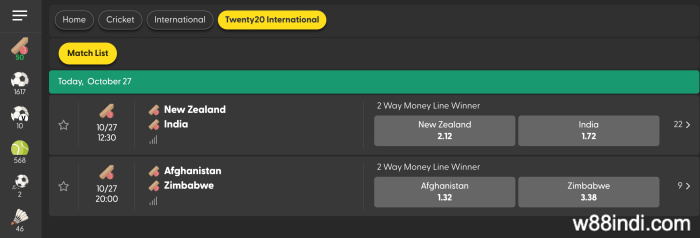
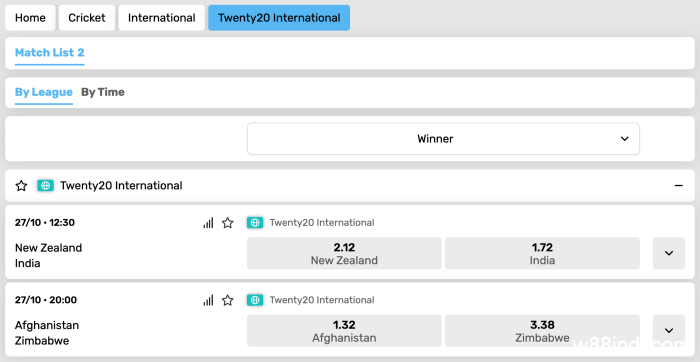
New Zealand
2.12
1 ÷ 2.12
47.2%
India
1.72
1 ÷ 1.72
58.1%
Total
47.2% + 58.1%
105.3%
In a fair two-way market, the probabilities would add up to exactly 100%. The extra 5.3% is the bookmakers’ margin, which is built into prices to secure a profit. This means implied probability is slightly inflated, so it should be read as the bookmaker’s price, not the true, real-world chance of a result.
Use the figures as a comparison tool
Use the figures as a comparison tool. Convert the odds for both sides, then check them against our own view from form, pitch and player research. If your analysis rates a team higher than its implied probability, the price may deserve a close look. Odds also move after team news, the toss, and weather, so recheck them before placing a bet.
#6. Study Powerplay, Middle-Over, and Death-Over performance
T20 innings turn in three phases, and teams are rarely equally strong in all of them. The Powerplay covers the first six overs, when only two fielders are allowed outside the circle. Check how many runs a team usually scores here, how often it loses early wickets, and whether its new ball bowlers take wickets or leak runs.
Study Powerplay, Middle-Over, and Death-Over performance
The Middle-Over phase, from overs 7 to 15, is where innings are built or stalled. Look at how well a team rotates the strike, how its spinners control the scoring, and whether its batters collapse under pressure. Then check the Death-Over phase, overs 16 to 20, where finishers and yorker specialists matter most. A side with power-hitters and reliable Death-Over bowlers can win games it looked to be losing.
Compare both teams phase by phase to see where the match may be won. For example, a strong Powerplay batting side against a weak new-ball attack points towards a fast start.
#7. Match your findings to the right betting market
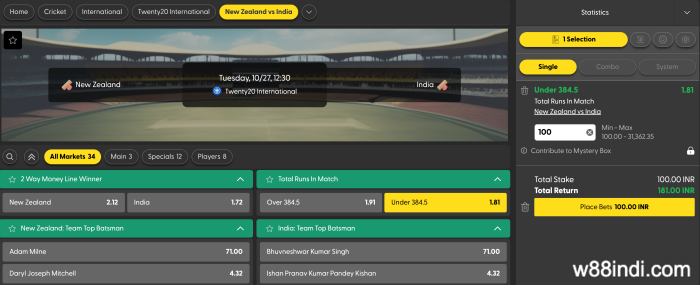
Once your research is done, pick the market that fits what you found. Pitch reports and venue scores point to total runs markets, while a strong Powerplay batting side against a weak new-ball attack suits Powerplay run markets. Form, head-to-head records, and the toss feed best into the match winner market.
Match your findings to the right betting market
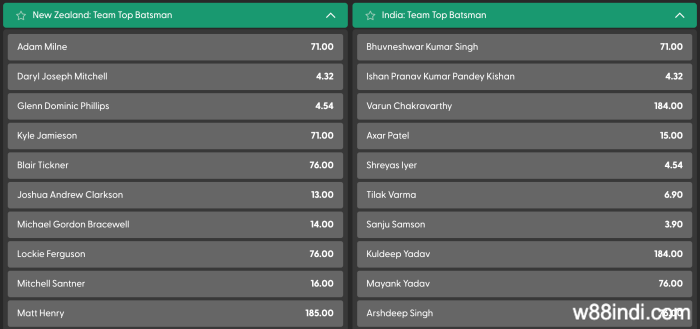
Player data works best in player markets. A batter with a high strike rate and good recent scores suits top batter markets, and a bowler with a low economy rate and regular wickets suits top bowler markets. If your analysis doesn’t clearly support a market, skip it, because market availability also varies between bookmakers.
#8. Set a budget and manage betting risks
Even the best analysis can’t remove risk, so decide how much you can afford to lose before the first ball is bowled. Set a fixed budget for the tournaments using only spare money, never funds meant for bills, rent, or savings. Keep each stake small and consistent, so a few lost bets won’t wipe you out.
Set a budget and manage betting risks
Don’t chase losses with bigger stakes, since that is how small losses turn into big ones. Use tools like deposit limits, session time, and cool-off breaks, and treat betting as entertainment rather than income. If it stops being fun or feels out of control, take a break and talk to someone you trust.
Common mistakes to avoid when analysing T20 World Cup matches
Even careful analysis can be undone by a few avoidable habits. These mistakes often have little to do with the numbers and more to do with how a bettor reacts to them during W88 betting.
Common mistakes to avoid when analysing T20 World Cup matches
Backing a favourite team out of loyalty: support for a side, especially India, can push you to ignore weak form, a poor pitch fit, or short odds. Judge each match on the data, not on who you want to win.
Following tipsters and social media predictions blindly: tips are opinions, and many give no reasoning or record of past results. Use them as a starting point, then check the claims against your own research.
Judging a player on one big innings or spell: a single standout performance can hide inconsistent form. Look at a run of recent matches before treating a player as a sure pick.
Placing impulsive live bets after a single big over: a six-filled over or a quick wicker can feel like a turning point, but one over rarely decides a T20 match. Reacting in the moment often means taking worse odds without any real analysis.
Stacking accumulators for a bigger payout: combining many selections multiplies the potential return, but every extra leg must also win, and the bookmaker’s margin is applied to each one. A single upset can wipe out the whole bet, so keep selections few and well researched.
Don’t follow tipsters and social media predictions blindly
Avoiding these habits keeps your decisions grounded in research. A calm, data-led approach will serve you better than reacting to hype, loyalty, or momentum.
Conclusion
The best T20 World Cup betting tips work together. Team form, pitch conditions, players’ stats, the toss, odds, match phases, and the right market each add a piece to the picture, and your analysis is strong when all of them point the same way. Stay disciplined by setting a budget, avoiding the common mistakes, and treating every bet as entertainment rather than income.